Skip to content

Next.js development agency for UK small businesses

We’re a small Next.js development agency for UK businesses, and this website runs on Next.js 16. We build fast websites, online shops and web apps where each page is either prebuilt or built on request, depending on what it does, and you own the code. Website packages start at £400, and custom builds get a fixed-scope price before any code is written. If WordPress would suit you better, we’ll say so.

This site runs on Next.js 16
Fixed price before any code
You own the code
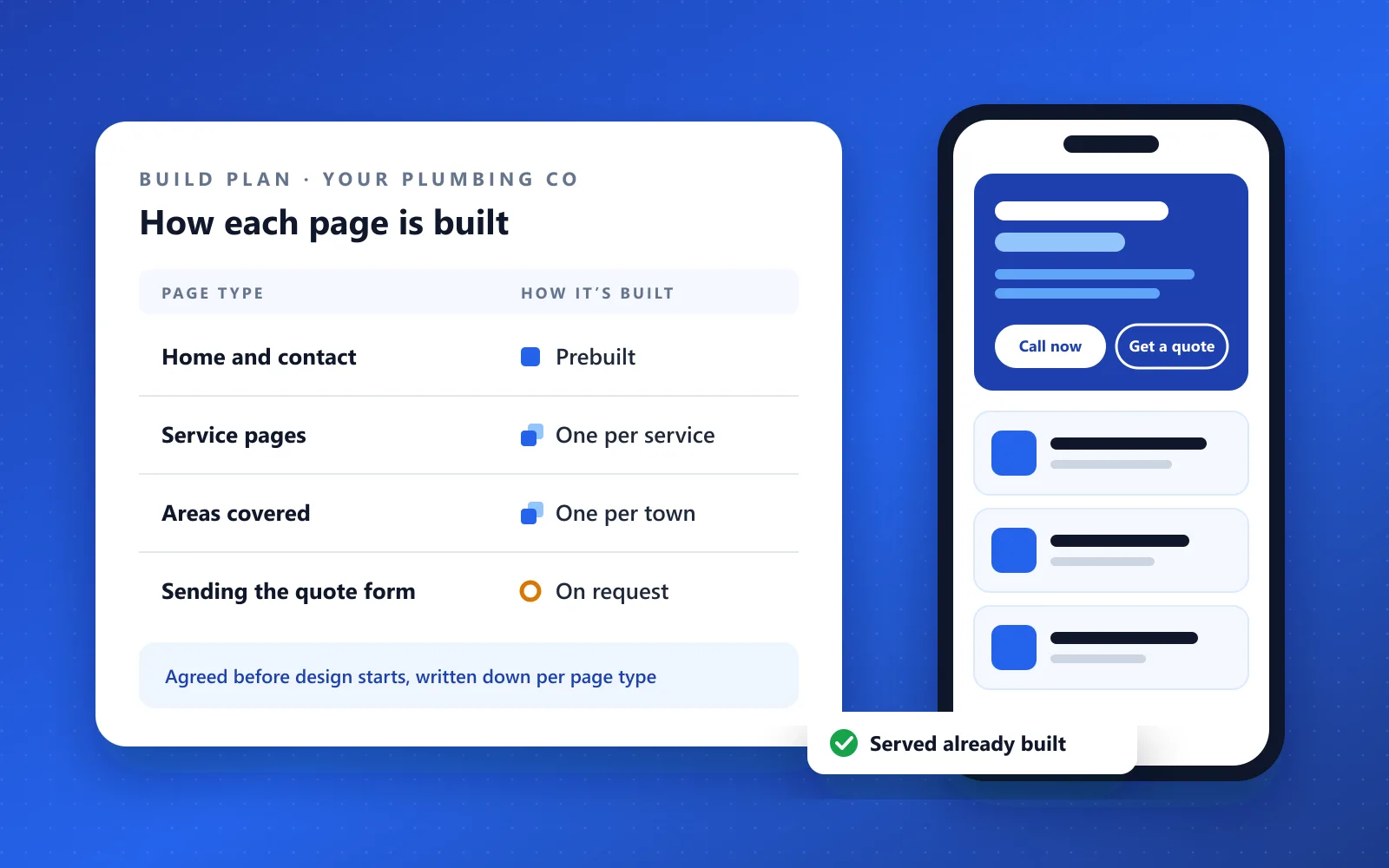
Illustration of a Next.js build plan for a made-up plumbing firm: each page type marked prebuilt or on request, beside a phone showing the finished homepage
WHAT WE BUILD

What our Next.js development agency builds

Next.js suits a business that wants a fast site it rarely has to think about, or a site that has to do more than explain your services. We use it for three kinds of job, and each one has a price before we start.

  1. Business websites

    Starter (£400, up to 5 pages, usually live in around 2 weeks), Business (£750) and Growth (£1,200). Every package includes a quote form and a reviews section. Tell us you want Next.js and we build it in Next.js.

  2. Online shops

    A small shop for up to 20 products (£900) or an online shop for up to 50 (from £1,500). The Gift Sip is a Next.js store that pulls its products from Printify and sends each paid order straight back to it.

  3. Web apps and integrations

    Customer portals, logins, booking flows and connections to the systems you already use. We quote these at a fixed scope once we know the job, and confirm the price in writing before any code is written.

Not sure which you need? Our web development page explains when a package is enough and when a custom build is worth the extra.

OUR OWN SITE

How this website is built on Next.js

The quickest way to judge a Next.js developer is to look at what they run themselves. This website is a Next.js 16 build on React 19. Below is every kind of page on it and how each one is made. The counts are read from the site’s own data, so they stay right as we add pages.

  • Prebuilt page: built once when the site deploys
  • Prebuilt, one per item: one page built per item in our data
  • Runs on request: runs on the server each time
  1. Home, about, contact and the hubs

    /services

    How many: 10pages

    How it’s built: Prebuilt page

    Why: Nothing on these changes from one visitor to the next, so each is built once when the site deploys and served from the nearest edge server.

  2. Service pages

    /services/web-design

    How many: 5pages

    How it’s built: Prebuilt, one per item

    Why: One template, one page per service, built from our service data. Adding a service is a data entry, not a new page file.

  3. Sub-pages and price pages

    /services/web-development/nextjs-development

    How many: 9pages

    How it’s built: Prebuilt page

    Why: Hand-built pages like this one. Every price on them is read from one packages file at build time, so a price change updates every page at once.

  4. Industry guides

    /industries/plumbers

    How many: 10pages

    How it’s built: Prebuilt, one per item

    Why: One page per trade, each from a typed data file. The build checks every one before it can go live.

  5. Articles

    /articles/what-is-nextjs-used-for

    How many: 21pages

    How it’s built: Prebuilt, one per item

    Why: Built from one JSON file. A link check runs before every build and stops it if an article links to a page that doesn’t exist.

  6. Case studies

    /projects/evietek

    How many: 4pages

    How it’s built: Prebuilt, one per item

    Why: The same pattern as the articles: one template, one page per project.

  7. Free tools

    /tools/website-grader

    How many: 2pages

    How it’s built: Prebuilt page

    Why: The tool pages are prebuilt like everything else. The check itself runs in the next row.

  8. The contact form and the grader

    /api/contact

    How many: 2pages

    How it’s built: Runs on request

    Why: Sending a message or checking a website has to happen fresh each time, so these run on the server on request and are never cached.

What the live site sends back

$ curl -I https://www.codekodex.com/
HTTP/1.1 200 OK
Server: Vercel
# the page was built in advance
X-Nextjs-Prerender: 1
# a nearby server sent it ready-made
X-Vercel-Cache: HIT

Headers checked from a UK connection on 11 November 2026, on the homepage, an article, an industry guide and a service sub-page; all four were prebuilt and served from the edge cache. Page counts come from the site’s data when it builds.

Pages in the table above that are prebuilt at every deploy
61 of 63
The version this site runs, read from its own package file
Next.js 16.1.6
CLIENT WORK

Two Next.js builds, and one we kept off Next.js

Each one is written up in full, with the figures from its case study.

  1. Next.js agency site

    An agency site whose team runs its own blog

    Evietek is an agency in London, Ontario. We turned its Figma designs into a Next.js site with an SEO-ready blog the team publishes on without a developer, about 12 posts a month since launch. Largest Contentful Paint is 0.8s, every Core Web Vitals check passes, and bookings and chats are up 25% since launch. Read the Evietek case study.

  2. Next.js shop

    A shop that sends its own orders

    A print-on-demand store we built solo in 4 weeks. Catalogue pages are rebuilt on a schedule so they stay fast, and each product page is rendered on the server so the price and options are always right. Every paid order goes to Printify automatically. Read The Gift Sip case study.

  3. Not Next.js

    A detailing site where plain HTML was the right call

    A mobile car-detailing business in Tyler, Texas needed its packages easy to read on a phone and a quick way to ask for a quote. It didn’t need a content editor, so we built it in HTML, CSS and JavaScript with a small PHP mailer, in 2 weeks. Mobile LCP on the landing page is 1.9s, and contact form completions are up 18%. Read the Mobile Detailers case study.

CHOOSING A PLATFORM

Next.js, WordPress or plain React?

Swipe the table to compare

Next.js isn’t the right tool for every business site. This is how the three compare for a small business, and who each one suits.

Next.js, WordPress and plain React compared for a small business website
What’s includedNext.jsWordPressPlain React
Editing it yourselfThrough a content editor, if we add one, or you send us changesYes: text, photos and pages in the dashboardNo. Every change goes through a developer
Speed on a phonePages can be prebuilt and served from the nearest serverDepends on the theme and how many plugins it runsThe page is drawn in the browser once the JavaScript has loaded
Showing up on GoogleGoogle gets the finished pageGoogle gets the finished pageGoogle has to run the JavaScript before it sees the content
UpkeepFramework and dependency updatesCore, theme and plugin updates, monthlyDependency updates
SuitsFast sites, custom features and online shopsOwners who want to edit everything themselvesTools that live behind a login

How Google handles JavaScript: Google Search Central, JavaScript SEO basics (2026). More detail in what Next.js is used for, Next.js vs React and our guide to choosing a website platform. Prefer WordPress? See our WordPress websites.

STRAIGHT TALK

When you don’t need Next.js

We build in Next.js, and in these four cases we’d still point you somewhere else.

  • You want to edit every page yourself

    Choose WordPress. You change text, photos and pages without ringing anyone, and almost any developer can take it over later. We build those too, at the same prices: WordPress websites.

  • Everything sits behind a login

    If nothing needs to be found on Google, a plain React app is simpler and can sit on cheap static hosting. Server rendering earns its keep on public pages.

  • It only has to last a few weeks

    A one-off campaign page with no second phase doesn’t need a framework. Build it in whatever’s quickest.

  • Nobody will keep it updated

    A Next.js site needs framework and dependency updates. If neither you nor we will do them, pick something you can look after, or add a care plan.

IN 2026

Is Next.js still a safe choice in 2026?

Yes. React’s own documentation recommends starting a new app with a framework and lists Next.js first. The question worth asking is who keeps your site on a supported version.

  • Next.js 16 is the current version

    Released on 21 October 2025 and in Active LTS, so it gets new features and security fixes (Next.js support policy, 2026).

  • Next.js 15 gets fixes until 31 January 2027

    Its security releases were extended past the original October 2026 end date. Version 14 and older get none.

  • About 1 in 5 developers use it

    21.5% of professional developers used Next.js in 2025, and 46.9% used React (Stack Overflow Developer Survey, 2025).

  • Who keeps it updated

    On a Care plan (£25/mo): framework and dependency updates, monthly, tested before they go live. Critical security fixes within 2 working days.

Next.js is free and open source under the MIT licence, so there’s no licence fee to pay.

PACKAGES

Next.js website prices

Next.js websites cost the same as every website we build. Starter is £400, Business £750 and Growth £1,200, each a fixed price with the full list of what’s included. Web apps and integrations are quoted at a fixed scope.

Starter

A professional first website for a new or small business.

£400

one-offNo VAT added
  • Up to 5 pages
  • Mobile-first design
  • Enquiry and quote request form, with spam protection
  • Reviews section, using your genuine reviews
  • SEO foundations: page titles, meta descriptions and a sitemap
  • GA4 and Google Search Console set up
  • 2 rounds of revisions
Ask about Next.js

Business

Most popular

A fuller site for an established business that wants to win more work online.

£750

one-offNo VAT added
  • Everything in Starter
  • Up to 10 pages
  • Help writing your core page copy
  • Blog
  • 3 rounds of revisions
  • 30 days of support after launch
Ask about Next.js

Growth

For businesses ready to compete harder in local search.

£1,200

one-offNo VAT added
  • Everything in Business
  • Up to 15 pages
  • Online booking calendar
  • Photo upload on the quote form
  • Local SEO setup: Google Business Profile and 10 citations
  • Enquiry Bot setup and first month included (£29/mo after that)
  • 60 days of support after launch
Ask about Next.js

Selling products online? Our shop packages start from £900. Compare the shop packages

  • 50% upfront, 50% on launch. No VAT added.
  • Bespoke projects (custom AI, web development and SEO projects): 50% upfront and 50% on completion up to £5,000; above £5,000, 40% upfront, then 30% and 30% at agreed milestones.
  • Not included: domain registration, charged at cost; third-party and platform fees, such as paid plugins, booking tool subscriptions, e-commerce platform subscriptions and payment processing fees; content beyond the package scope, such as extra pages or copywriting beyond your core pages.
  • Keep it updated with Care (£25/mo) or Care+ (£45/mo), monthly and optional. Every inclusion side by side: compare the website packages.
HOW IT RUNS

How a Next.js build runs with us

A Starter site is usually live in around 2 weeks, and a custom build usually takes 6–10 weeks from discovery to release. Either way, the steps run in this order.

  1. Plan each kind of page

    We list your page types (services, articles, products, account pages) and write down how each one is built: prebuilt, rebuilt on a schedule or run on request. It sets how fast the site is, so it’s agreed before design starts.

  2. Build with preview links

    You click through the real site on your own phone as it’s built, instead of looking at slides.

  3. Connect it and check it

    Forms, payments and bookings, with errors logged so nothing fails quietly. Then phone, browser, accessibility and speed checks, and a redirect map if your old pages have rankings to keep.

  4. Launch and hand over

    The code lives in a repository you own. Keep us on a care plan, or hand it to any developer.

CHOOSING A DEVELOPER

Six questions to ask any Next.js developer

You don’t need to be technical to judge a Next.js developer. Ask these six, and listen for answers about your site rather than about the framework.

  1. Which pages will be prebuilt, and which will run on request?

    A good answer names your page types and says why.

  2. Can I see a site you built?

    Open two of them on your phone, on mobile data. It takes two minutes.

  3. Which version will we launch on, and who keeps it updated?

    The current version, with a named person or plan for updates.

  4. Where will the code live?

    In a repository you own.

  5. What happens to my Google rankings?

    If you already have a site, the answer has to include a redirect map.

  6. Who will write the code?

    Ask who works on it day to day, and whether you can talk to them.

Slow down if you hear “we’ll do SEO after launch”, get a fixed price before anyone has asked what your pages do, or see no mention of handover. We’ll answer all six on a free 30-minute call.

FAQ

Next.js development questions

How much does a Next.js website cost in the UK?

With us, the same as any website we build: Starter is £400, Business £750 and Growth £1,200, all fixed prices. Shops start at £900. Web apps and integrations are quoted at a fixed scope, confirmed in writing before any code is written. A Care plan is £25/mo, and it’s optional.

Is Next.js still relevant in 2026?

Yes. React’s own documentation recommends starting a new app with a framework and lists Next.js first. Version 16 is in active support, and version 15 gets security fixes until 31 January 2027. In Stack Overflow’s 2025 survey, 21.5% of professional developers used it. This website runs on Next.js 16.

Is Next.js good for SEO?

It can send Google a finished page, which removes the main risk with JavaScript sites: Google has to render the JavaScript before it can index the content. It won’t rank a slow site with thin pages for you. We build page titles, schema, sitemaps and canonical tags into the templates, so nobody has to remember them.

Do I have to host a Next.js site on Vercel?

No. Next.js runs with every feature on any host that supports Node.js or Docker, and a static export runs on any web server with fewer features. This website is hosted on Vercel, and Evietek’s build uses Netlify and AWS. We set hosting up on your own account, so it stays your choice.

Can I update a Next.js website myself?

Yes, if we add a content editor. That’s how Evietek’s team publishes about 12 blog posts a month without a developer. Without one, you send changes to us, and the Care plan includes 30 minutes of edits a month. If you want to change every page yourself, WordPress may suit you better.

Can you take over or upgrade an existing Next.js site?

Yes. We check two things first: which version it’s on, and whether it uses the older Pages Router or the App Router, because the router decides most of the work. We look at the code, then quote a fixed scope. If any URLs change, we redirect them so you keep your Google rankings.

Should I use Next.js or WordPress?

WordPress, if you want to edit every page yourself and don’t mind monthly plugin updates. Next.js, if you want the fastest site, custom features or a shop, and you’re happy to send us changes or use a content editor. Both cost the same with us, and you own the code either way.

Free 30-minute call first

Want a straight answer on Next.js for your site?

Tell us what the site has to do. We’ll tell you which pages should be prebuilt and which should run on request, what it costs, and whether WordPress would suit you better.

  • Reply within one business day
  • You own the code and assets
  • Fixed-scope proposal in 48h
GET STARTED

Tell us about your Next.js project

Tell us what you need built: a website, an online shop, an integration or a web app. We’ll reply within one business day with clear next steps.

  1. 1

    We read it properly

    A real person reviews your notes and comes back within one business day.

  2. 2

    Book a free 30-minute call if it’s useful

    We go through what you need, your budget and your deadline, then tell you honestly which option fits.

  3. 3

    Fixed-scope proposal

    Scope, milestones and pricing in writing within 48 hours of the call.

Hours
Mon–Fri, 9am–5pm UK time
Working style
Remote-first, timezone friendly

We’ll only use these details to reply to your enquiry.

From £400

No VAT added
Get in touch