TL;DR
- Next.js is used to build websites and web apps that need to load fast and be found on Google: business sites, online shops, booking sites, customer portals and dashboards.
- It’s a framework built on React, made by Vercel and free to use under the MIT licence.
- Its main trick is choosing how each page is built: once when the site goes live, on a schedule, or fresh for each visitor.
- It’s a tool for developers, with no drag-and-drop editor. If you want to edit every page yourself, WordPress usually suits you better.
- Next.js 16 is the current version. Each version gets security fixes for two years after it comes out.
Next.js is used to build websites and web apps that need to load fast and be found on Google: business sites, online shops, booking sites, customer portals and dashboards. It’s a framework built on React, made by Vercel and free under the MIT licence. This website runs on it, and so do two of the client sites in our case studies.
This guide is for owners deciding what their next site should be built on, not for developers. It covers what Next.js does, the jobs it suits, when you don’t need it, and how to check whether a site already uses it. If you’re weighing WordPress, a custom build and website builders in general, our guide to choosing a website platform compares all three.
What Next.js is
#Next.js is a framework for building websites with React. React is the part that draws what you see and click: menus, forms and buttons. On its own, React leaves a lot to the developer, such as how pages map to web addresses and what runs on the server. Next.js fills in those gaps, so a developer starts with answers instead of a pile of decisions.
React’s own team recommends it. React’s documentation says to start any new React app with a framework, and lists Next.js first.
Free, but not a website builder
Next.js itself costs nothing. It’s open source under the MIT licence, so there’s no licence fee or monthly charge. What you pay for is the developer who builds the site and the hosting it runs on. There’s no drag-and-drop editor, so someone who writes code builds it.
What Next.js is used for most often
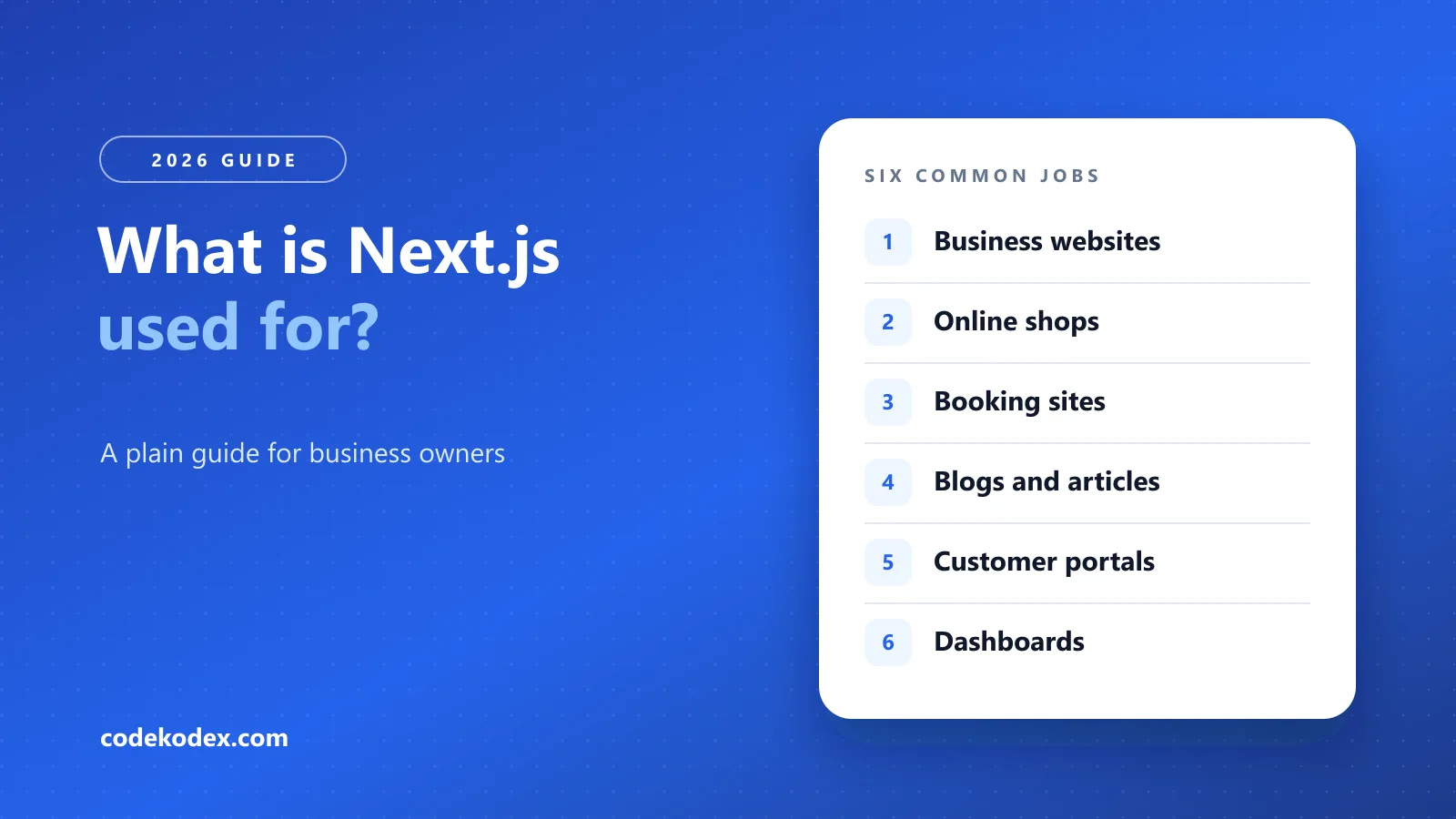
#These are the kinds of site built in Next.js most often. What they share is a mix of pages that need to be found on Google and parts that have to respond the moment someone taps.
Common uses of Next.js
Business websites
- Why Next.js suits it
- Pages can be prebuilt, so they load fast and Google reads them straight away
- What it looks like
- A plumber’s site with a page per service and per town, and a quote form
Online shops
- Why Next.js suits it
- Product pages load fast and can be found on Google, while the basket and checkout stay interactive
- What it looks like
- A shop that pulls its products from a supplier and takes payments online
Booking sites
- Why Next.js suits it
- Public pages need to rank, and the booking steps need to feel like an app
- What it looks like
- A clinic where patients pick a treatment and a time
Blogs and content sites
- Why Next.js suits it
- Articles are prebuilt and can be published from a content editor without a developer
- What it looks like
- A firm publishing a few articles a week
Customer portals
- Why Next.js suits it
- Logins, permissions and each customer’s own data are handled on the server
- What it looks like
- A portal where clients upload documents and see how their job is going
Dashboards and web apps
- Why Next.js suits it
- The first screen can be built on the server, then the app takes over
- What it looks like
- An admin area showing today’s bookings or orders
| Used for | Why Next.js suits it | What it looks like |
|---|---|---|
| Business websites | Pages can be prebuilt, so they load fast and Google reads them straight away | A plumber’s site with a page per service and per town, and a quote form |
| Online shops | Product pages load fast and can be found on Google, while the basket and checkout stay interactive | A shop that pulls its products from a supplier and takes payments online |
| Booking sites | Public pages need to rank, and the booking steps need to feel like an app | A clinic where patients pick a treatment and a time |
| Blogs and content sites | Articles are prebuilt and can be published from a content editor without a developer | A firm publishing a few articles a week |
| Customer portals | Logins, permissions and each customer’s own data are handled on the server | A portal where clients upload documents and see how their job is going |
| Dashboards and web apps | The first screen can be built on the server, then the app takes over | An admin area showing today’s bookings or orders |
Each page built the right way
#Most of what makes Next.js useful comes from one feature. The developer decides, page by page, when each page gets built.
- Built once, when the site goes live: your home, about and service pages, which are the same for every visitor
- Rebuilt on a schedule: a product list or article index that changes a few times a day
- Built fresh for each visitor: an account page, or anything showing prices or stock that must be exact
- Built in the visitor’s browser: an interactive tool such as a quote calculator
A prebuilt page arrives finished, which is why it’s fast and why Google can read it straight away. On this website, every public page is prebuilt and served from the nearest server. Only sending the contact form and running our website grader happen fresh each time. Our Next.js development page shows every kind of page on the site and how each one is built.
Key takeaway
A Next.js site that builds every page fresh for every visitor, because that was easiest during development, can end up slower than a decent WordPress site. The framework gives you the choice. Someone still has to make it, page by page.
Next.js sites we’ve built
#Evietek, an agency website
An agency in London, Ontario. Its blog posts are prebuilt, and the team publishes about 12 a month without a developer. Largest Contentful Paint is 0.8s, and bookings and chats are up 25% since launch. Read the Evietek case study.
The Gift Sip, an online shop
A print-on-demand store we built solo in 4 weeks. Catalogue pages are rebuilt on a schedule, and each product page is rendered on the server so the price and options are always right. Paid orders go to Printify automatically. Read The Gift Sip case study.
This website
Built on Next.js 16. The service pages, industry guides and articles are each built from data files, and a link check runs before every build, so a broken internal link stops the site going live.
When you don’t need Next.js
#For plenty of small businesses, Next.js is more than the job needs. These are the cases where we’d build something else.
You want to edit every page yourself
WordPress lets you change text, photos and pages from a dashboard, and almost any developer can take it over later. A Next.js site can have a content editor added, but WordPress does it out of the box. We build WordPress websites too.
It’s a few pages that rarely change
A small site with a contact form can be plain HTML, which costs next to nothing to host and has almost nothing to update.
Nobody will keep it updated
Next.js releases new versions and stops fixing old ones on a published schedule. A site nobody updates keeps working, but it stops getting security fixes.
Everything sits behind a login
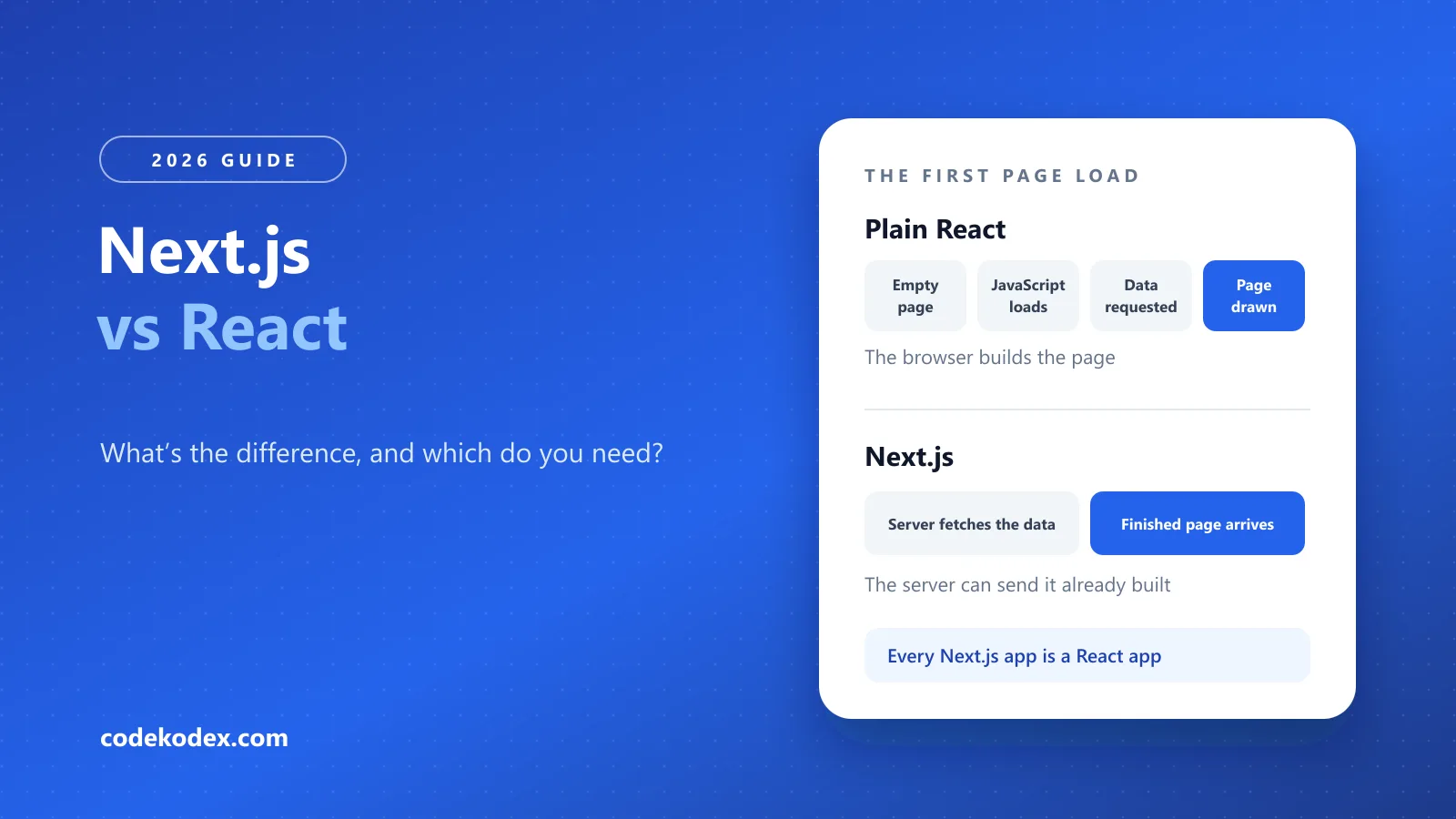
If nothing needs to be found on Google, a plain React app is simpler to host. Our guide to Next.js vs React covers that choice.
From experience
Alex Carter
Two of the four client sites in our case studies aren’t built on Next.js, and that was deliberate. Murff’s Bakery, a home bakery in Washington, D.C., is on WordPress so the owner can update her menu and photos herself. Mobile Detailers, a car-detailing business in Tyler, Texas, is plain HTML, CSS and JavaScript with a small PHP mailer, because it had five pages and no need for a content editor. Both took about two weeks to build.
Is Next.js still a safe choice in 2026?
#Yes. It’s widely used, actively supported and free. The Next.js support policy says how long each version gets fixes: the newest version gets new features and security fixes, and each version keeps getting critical security fixes for two years after it comes out.
Next.js versions in November 2026
October 2023
Next.js 14
No longer supported, so it gets no security fixes.
October 2024
Next.js 15
Security fixes only, extended to 31 January 2027.
October 2025
Next.js 16
The current version, with new features and security fixes. Start new sites here.
- of professional developers used React, which Next.js is built on
- 46.9%
- Stack Overflow Developer Survey, 2025
If someone proposes starting a new site on an older version, ask why. And ask who will keep it updated after launch, because that matters more than which version it starts on.
How to tell if a site uses Next.js
#A two-minute check
Open the site, view the page source and search for “/_next/”. If the addresses of its scripts and stylesheets start with it, it’s a Next.js site. It’s a quick way to check a developer’s portfolio before you hire them.
Is Next.js right for your project?
#Next.js is likely a good fit if
0 of 4 completed
If most of that fits, our websites start at £400 and online shops at £900, the same whether we build in Next.js or WordPress. Our Next.js development page covers what we build, how a build runs and what it costs.
Frequently Asked Questions
#Is Next.js free to use?
Yes. Next.js is open source under the MIT licence, so there’s no licence fee and no charge per user. What you pay for is the developer who builds the site and the hosting it runs on. A mostly prebuilt site is cheap to host. One that builds every page on request costs more to run.
Who makes Next.js?
Vercel, which also runs a hosting platform for it. Because Next.js is open source, you don’t have to host with Vercel: it runs with every feature on any host that supports Node.js or Docker. This website is hosted on Vercel, and Evietek’s Next.js site uses Netlify and AWS.
Is Next.js better than WordPress for a small business?
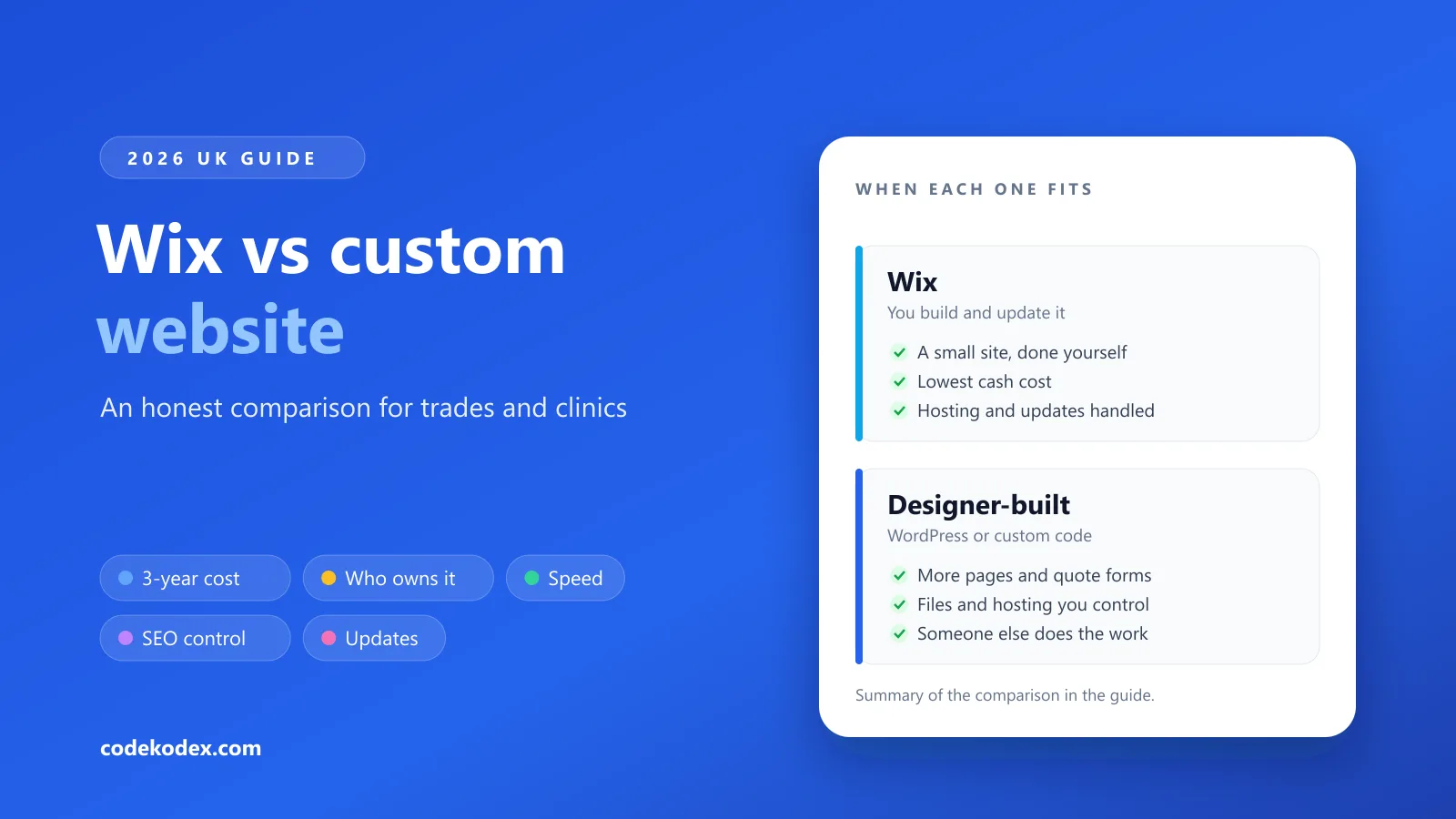
Neither is better for everyone. WordPress suits owners who want to edit every page themselves and don’t mind monthly plugin updates. Next.js suits businesses that want the fastest site, custom features or an online shop, and are happy to send changes to a developer. With us, both cost the same.
Is Next.js only for big companies?
No. What matters is whether someone will look after it, not the size of the business. We’ve built a Next.js agency website and a Next.js shop, and this website runs on it. Our websites start at £400. If nobody will keep the site updated, choose something simpler.
Can Next.js run an online shop?
Yes. Product pages can be prebuilt so they load fast and appear on Google, while the basket and checkout run on the server. The Gift Sip is a Next.js store that pulls its products from Printify and takes payment through PayPal. Our shop packages start at £900.
Want to know if Next.js suits your site?
Tell us what the site has to do. We’ll tell you which pages should be prebuilt, what it costs, and whether WordPress would suit you better. Websites start at £400.
Sources
Version dates and support periods — Next.js
Support policy, checked November 2026
React and Next.js usage — Stack Overflow
2025 Developer Survey, web frameworks
Starting a React app with a framework — React
Creating a React App
Where Next.js can be hosted — Next.js
Deploying, 2026
Licence — GitHub
MIT licence
- #what is next js used for
- #next.js
- #react framework
- #website platforms
- #web development