
TL;DR
- An AI consultant spends most of their time on four things: interviewing the people who do the work, checking whether the data exists, deciding what’s worth doing first and writing those decisions down.
- Very little of it involves AI models. A good consultant may not touch one during an assessment.
- What you’re paying for is a decision you can act on. If an engagement ends with everyone agreeing it was interesting, you haven’t bought anything.
- There are four kinds of AI consultant: strategy, technical, implementation partner and embedded advisor. They aren’t interchangeable.
- The skills that matter are unglamorous: asking awkward questions, writing plainly and being willing to recommend doing nothing.
- A consultant can’t fix a process nobody has written down, make your decisions for you or produce data you never recorded.
What does an AI consultant do? Mostly four things: talk to the people who do the work to find out how it really gets done, check whether the data needed to automate any of it exists, decide which opportunities are worth pursuing and in what order, and write all of that down clearly enough for someone to act on.
Notice what isn’t on that list. Choosing models, writing prompts and configuring platforms come after the decisions, and a good consultant may do none of it during an assessment. If someone leads with tools, you’re probably talking to a vendor. The technical work comes later, and it’s often done by a different person.
Who this is written for
Owners and managers of UK small businesses thinking about hiring an AI consultant, who want to know what they’d be paying for. If you’re thinking of becoming one, there’s a short, honest section near the end.
What does an AI consultant do day to day?
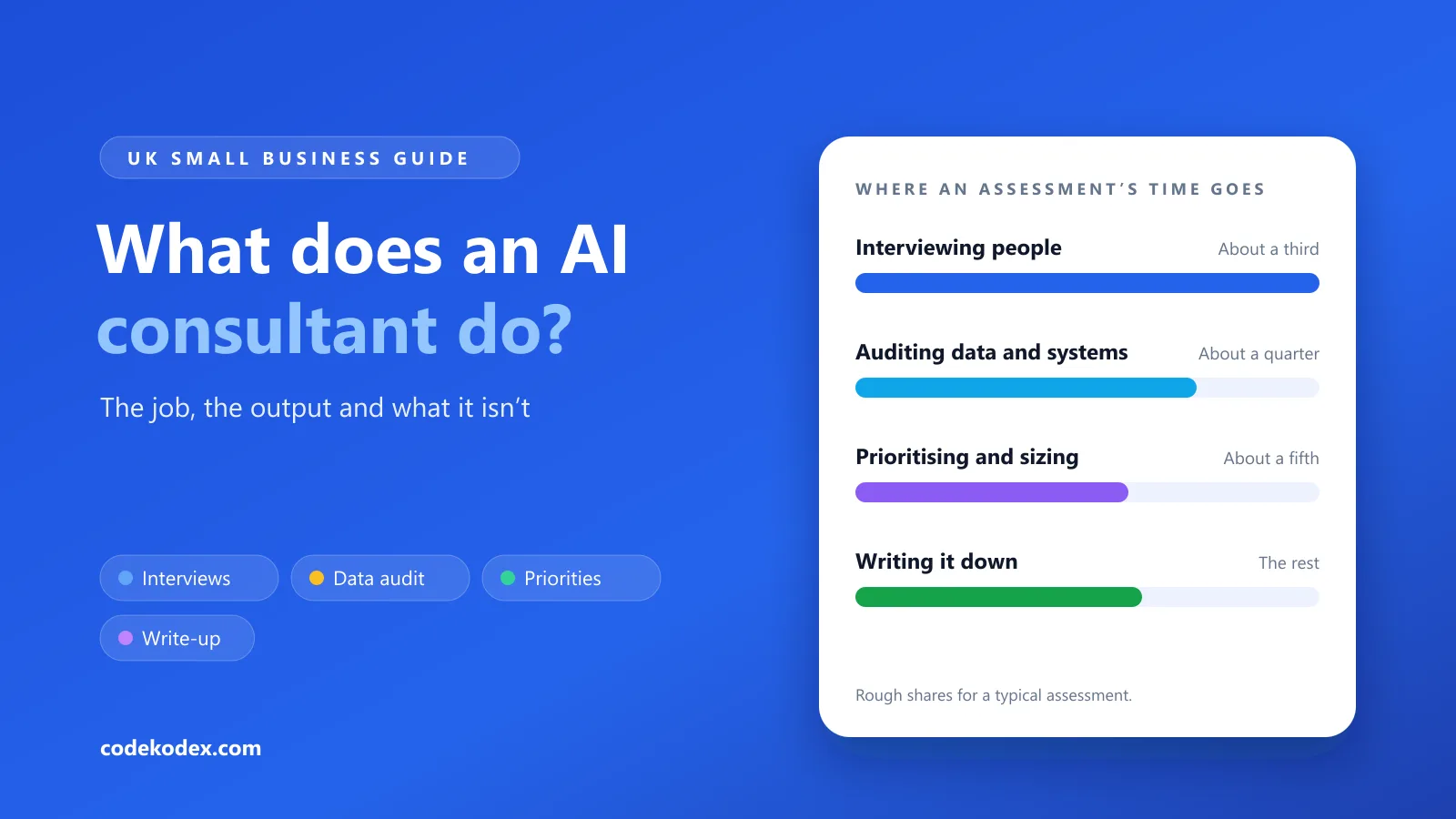
#This is roughly how a typical assessment’s time divides. The proportions surprise people, which says a lot about how this work is usually sold.
Where the hours go
Interviewing people: about a third of the time
Sitting with the person who answers the enquiries, the one who chases the documents, the one who writes the proposals. Asking what their process is gets you the official version. Asking what they did yesterday, and why, gets you the real one. Most opportunities sit in the gap between the two, and it only shows up in conversation.
Auditing data and systems: about a quarter
Finding out what information exists, where it lives, whether it can be reached and whether it’s consistent enough to use. It’s the least interesting part of the job and the part that most often kills an idea, which is why it happens early.
Prioritising and sizing: about a fifth
Turning a list of possibilities into an ordered list of decisions, with a rough cost and benefit against each. The arithmetic is easy. The hard part is putting a line through the idea the client is most excited about when the numbers don’t support it.
Writing it down: the rest
A short note for each candidate: what it is, whether the data supports it, roughly what it would cost and save, and a recommendation. Plain sentences, no framework diagrams. The test is whether someone who wasn’t in the room can act on it.
Key takeaway
More than half the job is listening and writing. That sounds underwhelming for something called AI consulting, and it’s exactly why the work is worth paying for: almost nobody inside a busy business has the time or the distance to do it.
What a typical two-week AI assessment looks like
#Many AI consultancies sell a two-week assessment as their first piece of work. Here’s how one usually runs, so you know what you’d be buying and what it would ask of your team.
A typical assessment, start to finish
Days 1–2
Framing and access
Agreeing what question the engagement answers, who needs to be spoken to, and getting read access to the systems involved. Delays here are usually about passwords, not decisions.
Days 2–5
Interviews with the people doing the work
Four to eight conversations of about forty minutes, deliberately including the most junior person who handles the process, because they know where the workarounds are.
Days 4–7
Data and systems audit
Does the information exist, can it be reached, is it consistent and is there enough of it? It runs alongside the interviews, because each raises questions for the other.
Days 7–9
Candidate list and sizing
Every idea raised gets a feasibility verdict and a rough size. Most are ruled out here, and the reasons are part of what you’re paying for.
Days 9–11
A working session on the shortlist
Taking the top three to five back to the decision makers and arguing about them. This is where the recommendation really gets made, not in the write-up afterwards.
Days 12–14
Write-up and handover
The register, the recommendation, the success measures and the baseline to take before anything changes. Short enough to read in one sitting.
The step people underestimate is the working session. A written recommendation delivered cold gets read, filed and forgotten. One argued through with the people who have to live with it gets acted on. If a proposal has no session like that, ask where the decision is supposed to happen.
For a business of five or twenty people, two weeks is often more than the question needs. Our AI Opportunity Review is the short version, for £149: a 1-hour remote session with you and the person who does the work, a quick look at your data and systems, and a written shortlist of your top 3 use cases within 5 working days. Each one gets a feasibility verdict, a rough cost and a likely saving, and the recommendation can be “not yet”.
What an AI consultant produces
#Good advisory work ends with something short. Four things, and none of them needs to be a slide deck.
- A prioritised list of candidate uses, each with a feasibility verdict and a rough size, including the ones recommended against and why
- A note on the data: what exists, what doesn’t and what would need to start being recorded
- A recommendation with a sequence, where each step makes the next one cheaper
- Success measures and a baseline: today’s numbers, recorded before anything changes
The baseline is the part people skip
Without a measurement of how things are now, taken before any work starts, you can never show an improvement afterwards. That’s how a project that worked can still be cancelled at the first budget review: nobody could prove it had.
What an AI consultant doesn’t do
#It’s worth being blunt about this, because mismatched expectations cause more disappointment than poor work does. An AI consultant won’t:
- Produce data you never recorded. If nobody logged which enquiries became customers, no consultant can recreate that history
- Fix a process nobody has written down. They can tell you it’s the blocker, but writing it down is your team’s job, and that’s where most of the benefit sits anyway. Start with where service businesses waste time
- Make the decision for you. They narrow it, size it and recommend, but the trade-offs are yours to accept
- Build the thing, unless that’s scoped separately. Advice and delivery are different pieces of work, often done by different people
- Guarantee a return. Anyone promising one from an assessment is describing something a document can’t do
- Replace someone on your side. Without an owner inside the business, an engagement produces a report and nothing else
- of AI projects without AI-ready data will be abandoned through 2026, Gartner predicted
- 60%
- Gartner, 2025
- of companies abandoned most of their AI initiatives before production, up from 17% a year earlier
- 42%
- S&P Global, 2025
Those figures are why the job looks the way it does. When RAND interviewed 65 data scientists and engineers, the root causes of failure they described were mostly decided before anyone built anything: misunderstanding the problem, lacking the data, chasing the newest technology, weak infrastructure and problems too hard for AI to solve. That’s the window advisory work operates in. Most of this research looks at larger companies, but a ten-person firm can make the same mistakes on a smaller budget.
Four kinds of AI consultant
#The title covers four quite different jobs. Hiring the wrong kind is a common and expensive mistake.
Which kind of AI consultant you’re looking for
Strategy advisor
- What they do
- Assessment, priorities, business case and governance. Rarely touches code
- Right when
- You don’t yet know what to do, or several people disagree
Technical or machine learning specialist
- What they do
- Feasibility on hard problems, model choice and testing
- Right when
- The idea involves prediction, custom models or unusual data
Implementation partner
- What they do
- Advises and builds, so the recommendations have to survive being built
- Right when
- The problem is fairly clear and you want one accountable party
Embedded or fractional advisor
- What they do
- Ongoing direction, usually a day or two a month
- Right when
- You have people in-house who need steering rather than doing
| Kind | What they do | Right when |
|---|---|---|
| Strategy advisor | Assessment, priorities, business case and governance. Rarely touches code | You don’t yet know what to do, or several people disagree |
| Technical or machine learning specialist | Feasibility on hard problems, model choice and testing | The idea involves prediction, custom models or unusual data |
| Implementation partner | Advises and builds, so the recommendations have to survive being built | The problem is fairly clear and you want one accountable party |
| Embedded or fractional advisor | Ongoing direction, usually a day or two a month | You have people in-house who need steering rather than doing |
For most UK small businesses, the honest answer is an implementation partner or nobody. Strategy-only advice makes sense once an organisation is big enough that getting everyone to agree is the real problem. A technical specialist is the right call less often than the market suggests, because most business uses of AI are about finding information and running workflows, not building models.
The skills that matter
#If you’re weighing someone up, these tell you more than a list of technologies. Anyone can learn to talk fluently about AI in a weekend.
Asking the question people are avoiding
Every business has one. Why does this process have three exceptions nobody wrote down? Why do two people quote different prices for the same job? A consultant who doesn’t raise those has had a comfortable engagement and produced very little.
Writing plainly
The output is words. If a recommendation needs someone to walk you through it, it won’t survive being forwarded to the person who controls the budget.
Knowing what data can and can’t support
Not building models: recognising within an hour that an idea depends on information that was never captured. That one judgement prevents a lot of the failures above.
Being willing to recommend nothing
The hardest one commercially, and the clearest signal. Anyone who has done this work honestly for a few years has told clients to stop, wait or fix something else first.
From experience
Alex Carter
I sit in these conversations to write them up rather than to run the technical work, which turns out to be a useful vantage point. The thing I notice most is how much of the value gets created in the interviews rather than in the analysis. A client once described their enquiry process to me in four steps, confidently, and then the person who actually handles enquiries described seven — including two workarounds invented because a system field did not exist. The four-step version would have produced a perfectly logical recommendation for a process nobody follows. Nothing in a document would have caught that. Forty minutes with the right person did.
Consultant, developer or neither?
#A quick way to work out which you need.
You need a consultant
You have a list of ideas and no way to rank them
You need a developer
You have one agreed problem and a clear scope
You need a consultant
You’re not sure your data supports the idea
You need a developer
You’ve already checked that the data works
You need a consultant
A previous attempt failed and nobody agrees why
You need a developer
A previous attempt worked and you want more of it
You need a consultant
There are unanswered questions about data protection
You need a developer
Your position on data protection is already written down
You need a consultant
The decision spans more than one team
You need a developer
One person can sign off on what gets built
You have a list of ideas and no way to rank them
You have one agreed problem and a clear scope
You’re not sure your data supports the idea
You’ve already checked that the data works
A previous attempt failed and nobody agrees why
A previous attempt worked and you want more of it
There are unanswered questions about data protection
Your position on data protection is already written down
The decision spans more than one team
One person can sign off on what gets built
And the third option is neither. If the whole opportunity is one obvious task worth a couple of hours a week, an off-the-shelf tool set up by someone on your team will beat any engagement on cost. Our guide to AI tools for service businesses covers the main ones. A consultant worth hiring will tell you that on the first call.
See how it worksAI consulting for UK small businessesHow our AI consulting works: a free 30-minute call, then the AI Opportunity Review, the six data questions we ask, and the UK rules that apply.Do the free version firstIs your business ready for AI? A practical self-assessmentBefore paying anyone, run the free version: a readiness check you can complete yourself in an afternoon.If you’re thinking of becoming one
#A short, honest note, since people arrive at this question from both directions. The job is much less technical and much more editorial than it looks from outside. If you’re good at interviewing people, writing clearly and sitting with the discomfort of telling a paying client their favourite idea won’t work, you have most of it.
What you do need technically is enough understanding to judge feasibility honestly: what searching your own documents with AI can and can’t do, how much history a prediction needs and roughly what things cost to run. That’s working knowledge, not a research background. What sinks people is the opposite mix: deep technical skill with no appetite for the organisational work, which produces impressive pilots nobody uses.
Frequently Asked Questions
#Does an AI consultant build the AI?
Sometimes. A strategy advisor assesses and recommends without building. An implementation partner does both, so their advice has to survive being built, which is a useful check. Find out which you’re buying in the first conversation, because plans written by people who never deliver tend to underestimate data access and integration.
What qualifications should an AI consultant have?
Formal qualifications matter less than in most advisory work, because the field is too new for certificates to mean much. Ask what they’ve shipped, what it measurably changed, what went wrong and when they last advised a client not to go ahead. The specifics of one real project tell you more than a list of technologies.
How is an AI consultant different from a management consultant?
The overlap is real: process mapping, priorities and managing change are the same disciplines. The difference is the feasibility judgement. An AI consultant should be able to tell you within an hour whether an idea is possible with the data you have. A management consultant without that skill can produce a sound plan that can’t be built.
Does a small business need an AI consultant?
Usually less than a large one. A small business needs an honest answer on which one or two jobs are worth automating and whether the data supports them. That’s an hour’s conversation and a short written review, not a long programme. If the opportunity is one obvious task, an off-the-shelf tool may be enough.
Can one person do this, or do I need a firm?
For a small business, an individual or a small team usually fits better. The work is interviews, an audit and a written recommendation, and adding people mostly adds coordination. A firm earns its fee when the organisation is big enough that getting people to agree is the problem, or when delivery spans several systems at once.
How do I know whether an AI engagement was worth it?
Check whether it produced a decision you could act on and a baseline to measure what follows. At the end, you should be able to say what you’re doing next, what you’re deliberately not doing and how you’ll know in three months whether it worked. If you can, it did its job.
The job isn’t what the title suggests. It’s mostly interviewing people about work they take for granted, checking whether the data exists and writing decisions down in plain sentences. The technology part is real but small, and the consultants who get results are the ones who resist starting there.
Want to know what this would look like for your business?
Start with a free 30-minute call. If AI looks worth it, our AI Opportunity Review costs £149: an hour with you and the person who does the work, then a written shortlist of your top 3 use cases within 5 working days.
If the honest answer is “not yet”, we’ll say so.
The short version
- 1
An AI consultant spends most of their time interviewing the people who do the work, auditing the data, prioritising and writing decisions down.
- 2
More than half the time is listening and writing. Very little of it involves AI models.
- 3
A typical assessment elsewhere runs about two weeks, and the decision gets made in a working session, not the write-up. For a small business, a 1-hour review and a written shortlist is often enough.
- 4
What they produce: a prioritised list, a note on the data, a sequenced recommendation and a baseline taken before anything changes.
- 5
There are four kinds: strategy, technical, implementation partner and embedded. Most small businesses want an implementation partner or nobody.
- 6
The best sign of a good consultant is a willingness to recommend doing nothing.
Sources
AI project failure rates and root causes — RAND Corporation
The Root Causes of Failure for Artificial Intelligence Projects and How They Can Succeed, 13 August 2024
AI projects without AI-ready data — Gartner
Press release, 26 February 2025
Companies abandoning AI initiatives — S&P Global Market Intelligence
Voice of the Enterprise: AI & Machine Learning, Use Cases 2025 (1,006 respondents in North America and Europe), 30 May 2025
- #what does an ai consultant do
- #ai consultant
- #ai consulting uk
- #ai assessment
- #ai consultant vs developer
- #becoming an ai consultant
- #ai for small business
- #ai project failure


